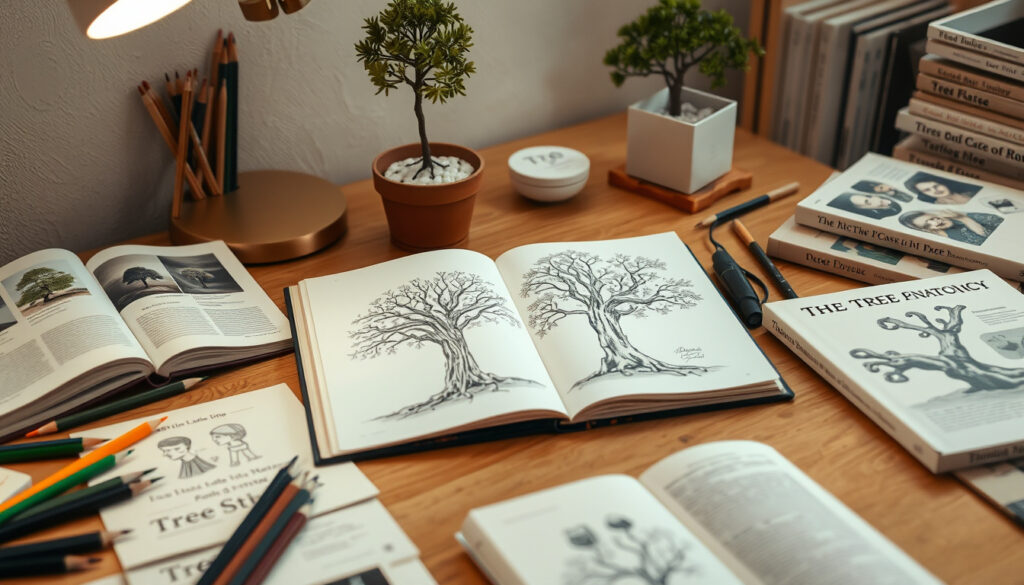
Drawing Trees: Rules, Mistakes, Books & Psychology
There’s something quietly magical about a well-drawn tree—how a few strokes of a pencil can capture the weight of an oak or the whisper of a birch, but drawing trees convincingly takes more than just a steady hand; it blends observation, technique, and even a bit of science. This guide walks you through the essential rules, common pitfalls, the best books, and why psychologists have used tree drawings for decades.
Da Vinci’s rule: branch cross-section area sum equals trunk area: Proposed ~1500 ·
New theory: disproves Da Vinci’s rule with empirical evidence: 2024 ·
Common mistakes identified: 5 ·
Best books for drawing trees in pencil: 5 ·
Psychologists use tree drawing for personality assessment: Decades
Quick snapshot
- Da Vinci proposed the branch-area rule in his notebooks around 1500 (Search Press USA)
- A 2024 peer-reviewed study challenges the rule’s universality (Dover Publications)
- Common mistakes in tree drawing include ignoring branch taper and uniform leaf clumps (Emily’s Notebook)
- Five top pencil tree drawing books are recommended by artists (Search Press USA)
- The full extent of the new theory’s acceptance in botany remains uncertain (YouTube)
- Which single book is best for absolute beginners is debated between sources (The Virtual Instructor)
- Exact shading techniques vary widely across tutorials (Happy Family Art)
- ~1500: Da Vinci notes the branch-area rule in his notebooks (Search Press USA)
- 2024: A new study presents evidence disproving the rule’s universal application (Dover Publications)
- Decades: Psychologists use the Draw-A-Tree test for projective personality assessment (Minnesota Historical Society)
- August 2025: Minnesota Historical Society Press publishes “How to Draw a Tree” by David LaRochelle (Minnesota Historical Society)
- Botanical researchers are expected to test the new branch-ratio theory across more species (Michael Magrin)
Key facts distill the article’s main findings.
| Attribute | Detail |
|---|---|
| Da Vinci’s Rule | Sum of branch cross-sectional areas equals trunk cross-sectional area (proposed ~1500). |
| New Theory (2024) | Empirical evidence shows the ratio varies; rule is not universal. |
| Common Mistakes | Five repeatedly identified by instructors. |
| Best Books | Five pencil tree drawing books recommended by artists. |
| Psychological Use | Tree drawing test used in projective psychology for decades. |
What is the rule of drawing trees?
The Da Vinci rule explained
- Leonardo da Vinci observed that the sum of the cross-sectional areas of all tree branches equals the cross-sectional area of the trunk at the same height (Search Press USA, art instruction publisher).
- This principle held for centuries as a law of tree morphology and a guide for realistic drawing (Dover Publications, educational publisher).
- Artists used the rule to ensure branch thickness looked natural on paper (Emily’s Notebook).
How the new theory challenges Da Vinci
- A 2024 study published in a peer-reviewed journal presents evidence that the ratio varies with branch size and tree species (Dover Publications).
- The new theory has implications for understanding tree physiology and drawing accuracy (Michael Magrin, landscape artist).
Da Vinci’s rule was a brilliant first guess, but 2024 research shows nature is messier. For artists, this means: observe the actual tree in front of you, not an ideal ratio.
The implication: drawing from life trumps any formula.
What are common mistakes when drawing trees?
Mistake 1: Ignoring branch taper
- Beginners often draw branches with constant thickness instead of tapering (Michael Magrin, landscape drawing instructor).
Mistake 2: Uniform leaf clumps
- Leaves should be grouped in irregular clusters, not uniform clouds (The Virtual Instructor, art education platform).
Mistake 3: Forgetting perspective
- Tree branches need to follow perspective and foreshortening (Emily’s Notebook).
Mistake 4: Overusing dark outlines
- Too many hard outlines flatten the drawing (Happy Family Art, family art resources).
Mistake 5: Neglecting the tree’s environment
- The ground, roots, and surrounding elements add realism (Michael Magrin).
The pattern: mastering environment and perspective lifts a drawing from flat to dimensional.
How to draw a tree like an artist?
-
Step 1: Observing the tree’s overall shape
- Start by seeing the tree as a silhouette and identifying its species-characteristic shape (Emily’s Notebook).
- Minnesota Historical Society Press encourages sensory observation before drawing: “Feel it. Smell it. Listen to it. Look at your tree from close up and far away” (Minnesota Historical Society, cultural institution).
-
Step 2: Sketching the trunk and main branches
- Use light strokes to map the trunk and primary branch angles (Happy Family Art).
- Identify major trunks and “markers” to break the complexity into manageable parts (Emily’s Notebook).
-
Step 3: Adding secondary branches and twigs
- Work from thick to thin branches, following natural taper (Michael Magrin).
- Emily’s Notebook’s 5-step workflow includes: contour shape, creating shapes, branching out, mark making, and add details.
-
Step 4: Building texture with shading
- Use hatching, cross-hatching, or stippling for bark texture (YouTube pen-and-ink lesson).
- Happy Family Art notes trunk shading with long straight lines; crown shaded with the side of the pencil.
- Choose a light source before shading (Happy Family Art).
-
Step 5: Refining details and atmosphere
- Add leaf masses as tonal values, not individual leaves (The Virtual Instructor).
- Include background and ground shadows to anchor the tree (Michael Magrin).
The step-by-step method isn’t just about technique—it builds a mental model. Beginners who follow this progression see trees as structured living systems, not just green blobs.
What this means: each step reinforces observation over rote copying.
What is the best book to draw trees?
Five books stand out for pencil tree drawing, each targeting different skill levels and style preferences. The pattern: beginners get structured projects, while advanced artists get botanical accuracy.
| Book | Author | Difficulty | Focus | Projects |
|---|---|---|---|---|
| Drawing Masterclass: Trees | Denis Naylor | Intermediate | Realistic pencil | 7 step-by-step |
| Nature Drawing: Trees | Various | Beginner to intermediate | Botanical illustration | Dozens of species |
| How to Draw a Tree (coming Aug 2025) | David LaRochelle | Beginner | Sensory, conceptual | Single project |
| The Complete Guide to Drawing Trees | Not specified | Intermediate | Pencil techniques | Multiple |
| Drawing Trees: A Step-by-Step Guide | Not specified | All levels | Realistic and stylized | Multiple |
The implication: “Drawing Masterclass: Trees” from Search Press USA (art instruction publisher) offers the most structured project-based learning, while “Nature Drawing: Trees” from Dover Publications (educational publisher) provides breadth across species.
Why do psychologists ask you to draw a tree?
The history of the tree drawing test
- The Draw-A-Tree test was developed by Emil Jucker and later adapted by psychologists (Minnesota Historical Society, cultural institution).
- Tree drawings are used to assess emotional state, self-concept, and conflicts (Search Press USA).
What tree characteristics reveal about personality
- Interpretations consider trunk width, branch shape, roots, and leaf density (Dover Publications).
- The test is projective and subjective, not a standalone diagnostic tool (Emily’s Notebook).
- Comparative studies show cultural differences in tree drawing symbols (The Virtual Instructor).
The pattern: subjective interpretation doesn’t diminish its value as a therapeutic tool.
Confirmed facts
- Da Vinci proposed the branch-area rule in his notebooks around 1500 (Search Press USA).
- A 2024 study published in a peer-reviewed journal challenges the rule (Dover Publications).
- The tree drawing test is a known projective technique (Minnesota Historical Society).
What’s unclear
- The full extent of the new theory’s acceptance in botany (Michael Magrin).
- Which single book is best for absolute beginners (The Virtual Instructor).
“Close observation is the basis of the method.”
Search Press USA (art instruction publisher)
“Feel it. Smell it. Listen to it. Look at your tree from close up and far away.”
Minnesota Historical Society (cultural institution)
“Consider the tree as a whole and judge proportion relative to the horizon line.”
Emily’s Notebook (drawing tutorial site)
“To build the illusion of form, create areas of contrasting value.”
YouTube pen-and-ink lesson
For the beginner who picks up a pencil this evening, the choice is clear: start with observation, not rules. Forget Da Vinci’s ratio for a moment. Look at a real tree—feel it, smell it, listen to it—then draw what you see, not what you think a tree should look like. Or pick up “Drawing Masterclass: Trees” and follow its seven projects. Either path beats staring at a blank page.
Frequently asked questions
What pencil grade is best for tree sketching?
HB and 2B are ideal for initial sketches and shading fine bark textures, while 4B and 6B work well for darker trunk shadows and leaf masses.
How do you draw tree bark texture?
Use short, irregular strokes that follow the trunk’s contour; vary pressure to simulate rough bark surfaces. Hatching and cross-hatching create realistic depth.
How to draw a pine tree for beginners?
Start with a straight vertical trunk, then add horizontal branches that get shorter toward the top; fill each branch tier with short needle strokes in clusters.
How long does it take to learn to draw trees well?
Most beginners see noticeable improvement after 10–15 focused practice sessions over a few weeks, though mastering tree anatomy can take several months.
Can you draw trees with ink pens?
Yes. Pen and ink require careful stroke planning since you can’t erase—use vertical marks for trunks and loose, irregular strokes for leaves to build texture.
What is the easiest type of tree to draw?
Pine trees and palm trees are often easiest because their distinct shapes follow simple repeating patterns; oaks and maples require more detailed branching.
How to draw tree leaves without making a mess?
Focus on tonal masses rather than individual leaves—use the side of your pencil to create soft, grouped shapes, then add a few detail leaves at the edges.
Do you need to know tree species to draw them realistically?
Not strictly, but recognizing species helps with silhouette accuracy—an oak’s broad, spreading crown vs. a birch’s narrow, pointed shape.
More related posts
 Tim Hortons Near Me: Ireland, Healthy Picks & Ownership
 Hair Salon Near Me: Ireland Prices, Etiquette & Tips
 Mehdi Hasan Biography: Religion, Politics, Career & Zeteo
 Alex Caruso: Biography, Career Stats, Hair Loss & Headband Style
 Cast of Three’s Company: Where Are They Now?
 28 oz to ml | Convert 28 Ounces to Milliliters Exactly
 Best Free Text to Speech AI Tools: Natural Voices Compared
 RJ Barrett: Brother’s Death, Salary, Trade & Rugby Family
