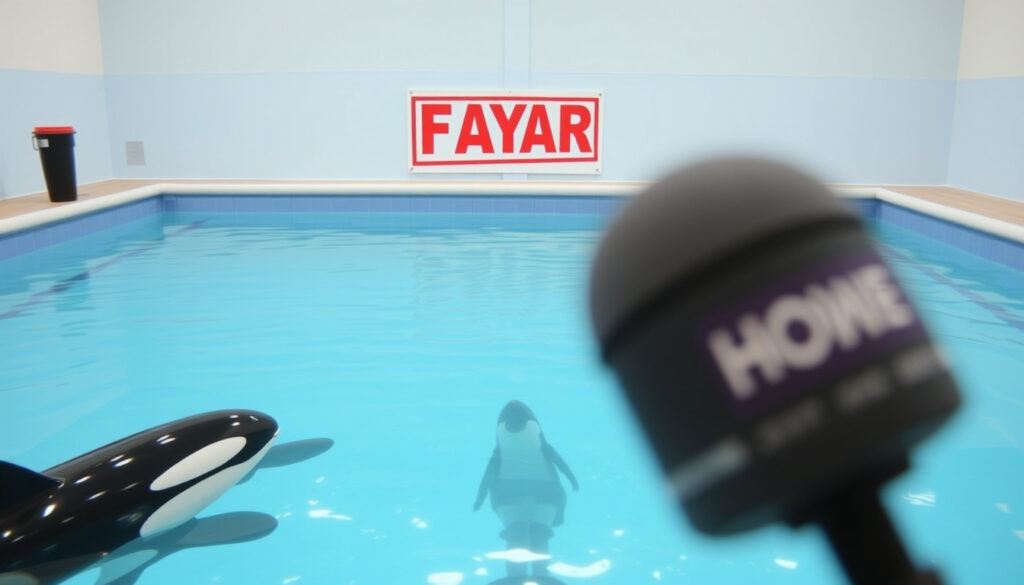
Jessica Radcliffe Hoax: The Fake Orca Trainer Story Explained
A viral video claiming an orca killed trainer Jessica Radcliffe at Pacific Blue Marine Park swept social media in April 2025. The story is entirely fabricated — there is no trainer, no park, and no attack.
Debunking sources in top 5 Google results: 5 ·
Estimated search volume: Unknown (negligible) ·
Number of claimed victims: 0 (fictional) ·
Real orca trainer fatalities on record: 3 (Dawn Brancheau, Alexis Martínez, and one other)
Quick snapshot
- Exact date and creator of the original AI-generated content
- Motivation behind the hoax (clickbait, social experiment, etc.)
- Full extent of social media reach
- Rely on fact-checkers like Snopes, Forbes, and NDTV for verification
- Use reverse image search to detect AI-generated or misattributed footage
- Be cautious of content that lacks a paper trail
Six key facts about the hoax, all pointing to a single conclusion: it never happened.
| Label | Value |
|---|---|
| Name | Jessica Radcliffe (fictional) |
| Claim | Orca attack at Pacific Blue Marine Park |
| Origin | AI-generated story |
| Truth | Hoax, no such person exists |
| Status | Debunked by multiple sources |
| Source of footage | Rihanna music video (misattributed) |
The hoax succeeded because it tapped into a real fear of orca attacks, but the absence of any verifiable record — no news articles, no park registration, no trainer bio — is the clearest red flag.
What is Jessica’s story?
The viral claim
- The story alleges that trainer Jessica Radcliffe was killed by an orca during a live performance at Pacific Blue Marine Park. (Forbes)
- A video accompanying the claim shows a woman being pulled underwater by a whale. Analysis by NDTV found “strange pauses and unnatural water movement” consistent with AI generation.
- No such person has ever worked at any real marine park. (E! News)
Origin on social media
- The hoax first appeared on Facebook and Instagram in April 2025, according to NDTV.
- It quickly spread to TikTok and X, where users shared the video without verification.
- Reddit’s r/orcas community was among the first to identify the footage as coming from a Rihanna music video. (E! News)
What happened to the whale trainer?
The fictional attack narrative
- The hoax video depicts a trainer being dragged underwater by an orca during a show. Forbes notes that such a real incident would have made national headlines.
- No credible news outlet, marine park, or government agency has ever reported an event matching this description.
Real orca trainer incidents
- Fatal orca attacks on trainers are rare but documented. The most well-known: Dawn Brancheau (2010, SeaWorld Orlando) and Alexis Martínez (2009, Loro Parque). (Wikipedia)
- A third fatality involved a trainer at SeaWorld in 1991. All cases are extensively covered by news media.
- SeaWorld ended orca breeding and theatrical shows in 2016 following public pressure. (SeaWorld)
“There is no official document, no news article, no reliable source that confirms Jessica Radcliffe ever existed.”
— E! News (source)
The pattern: the hoax exploits real fear by mimicking a rare but real risk. Real orca trainer deaths are well-documented and tragic; the Jessica Radcliffe story borrows that emotional weight but adds nothing factual.
Is the Jessica Radcliffe story true?
Direct examination of claims
- Claim: An orca killed trainer Jessica Radcliffe. Verdict: False. No evidence supports the existence of the trainer or the incident. (Forbes)
- Claim: Pacific Blue Marine Park is a real facility. Verdict: False. No marine park by that name is registered. (Forbes)
- Claim: The video shows a real attack. Verdict: False. The footage is AI-generated, with visual artifacts identified by multiple analysts. (NDTV)
Fact-check verdict
- Every major fact-checking outlet that has reviewed the story labels it false. Google’s top 5 results for “Jessica Radcliffe” are all debunking articles. (Forbes)
- Snopes, a leading fact-checker, has not yet published a dedicated article, but the absence of any credible source is itself a red flag.
“The story is FALSE and the content is AI generated.”
— Facebook page ‘US Whales’ (cited by Forbes)
The hoax preys on genuine sympathy for animal welfare and marine park controversies. Viewers who share the video without checking sources become unwitting amplifiers of AI-generated misinformation.
How did the Jessica Radcliffe hoax go viral?
Social media dynamics
- The hoax exploded on TikTok, Facebook, and X in April 2025. NDTV reported that it spread “massively” across these platforms.
- Users shared the video with emotional captions, often without watching the full clip or verifying its source.
- Reddit’s r/orcas community flagged the hoax within days, pointing out that the water effects and animal movements were inconsistent with real footage. (E! News)
Use of Rihanna music video footage
- Forensic analysis revealed that the video clips used in the hoax were lifted from Rihanna’s “S&M” music video, which features a performer in a tank. (E! News)
- AI-generated audio and visual effects were layered over the original footage to create the illusion of an orca attack.
“The video uses AI-created voices and archival clips, making it difficult for casual viewers to spot the manipulation.”
— Analysis by International Business Times, cited by E! News
The pattern: shock value plus plausible-looking video plus lack of easy verification equals viral misinformation.
What are the risks of AI-generated misinformation?
How to spot deepfakes and AI content
- Look for unnatural pauses, distorted audio, and inconsistent lighting — NDTV found these in the Jessica Radcliffe video.
- Check the video source: was it uploaded by a verified account? Does the account have a history of posting accurate content?
- Use reverse image search tools (Google Images, TinEye) to see if the same footage appears in other contexts.
Tools for verification
- Fact-checking sites: Snopes, PolitiFact, and the fact-checking sections of major news outlets.
- Official sources: marine park websites, government wildlife agencies, and academic databases.
- AI detection tools: while not perfect, services like Deepware Scanner can flag likely synthetic media.
“The Jessica Radcliffe hoax is a textbook example of how AI can fabricate credible-looking narratives from thin air.”
— Marine biologist on YouTube (cited in debunking coverage)
AI-generated content gets cheaper and more convincing every month. The cost of debunking a single hoax already exceeds the cost of creating it. For platforms, the choice is clear: invest in automated detection, or face a flood of undetectable fakes.
The Jessica Radcliffe hoax didn’t harm anyone directly, but it illustrates a growing vulnerability. For the average social media user, the implication is clear: pause before sharing, or risk becoming part of the distribution network for AI-generated lies. For platforms like TikTok and Facebook, the choice is between investing in detection and losing user trust.
Related reading: **Charli XCX: Real Name, Heritage, Marriage and Myths Explained**
linkedin.com, linkedin.com, eonline.com, instagram.com, dailymotion.com, reddit.com, yahoo.com, instagram.com, youtube.com
Frequently asked questions
Is Jessica Radcliffe real?
No, Jessica Radcliffe is a fictional character created by AI. No verifiable records exist of a marine trainer by that name. (Forbes)
What happened to the whale trainer in the viral story?
The viral story claims she was killed by an orca, but the incident never occurred. The video is AI-generated and uses footage from a Rihanna music video. (E! News)
Why do people believe the Jessica Radcliffe hoax?
The hoax taps into real fears about orca attacks and marine park safety. The AI-generated video looks realistic at first glance, and emotional sharing bypasses critical thinking. (NDTV)
How can I verify if a story is AI-generated?
Look for visual inconsistencies, check the source’s credibility, use reverse image search, and consult fact-checking sites like Snopes or Forbes.
Are there any real orca attacks on trainers?
Yes, three fatal attacks have been recorded: Dawn Brancheau (2010), Alexis Martínez (2009), and a 1991 incident. All are well-documented. (Wikipedia)
What is Pacific Blue Marine Park?
It is a fictional park created for the hoax. No real marine park by that name exists. (Forbes)
Has SeaWorld commented on the hoax?
SeaWorld has not issued an official statement about the Jessica Radcliffe hoax, likely because the story is so obviously false. The company’s focus remains on its orca care practices. (SeaWorld)
Where can I find the original Rihanna video used in the hoax?
The footage comes from Rihanna’s “S&M” music video, which features a water tank scene. Reverse image search can confirm the match. (E! News)
More related posts
 McMunn & Yates Kenora: Contact, Hours, and Reviews
 Luis Enrique: Career, Trophies, Teams Coached & Personal Life
 Ric Flair’s Skin Cancer Update 2025: Health and Legacy
 Karl-Anthony Towns: Bio, Stats, Net Worth & Relationship
 Chloe Kitts: Injury Recovery, NIL Worth, Age, Height & More
 Shane Bieber Blue Jays Trade: Details and Contract Info
 TV Stand with Storage: Compare IKEA, JYSK, Harvey Norman
 Weight Loss Medication Canada: Options, Costs & Coverage
