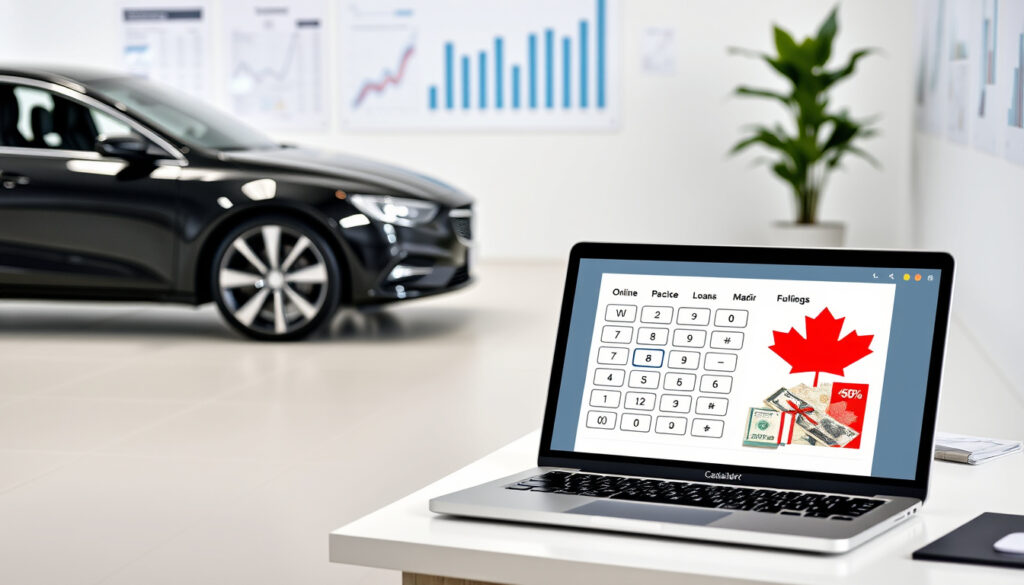
Auto Loan Calculator Canada: Monthly Payment Guide 2025
Figuring out your monthly car payment before walking into a dealership feels a lot like checking the weather before a road trip—it saves you from getting soaked. An auto loan calculator Canada tool does exactly that: it turns a pile of numbers (price, rate, term, down payment) into a clear monthly figure. In this guide, you’ll learn how to pick the right calculator among Canada’s top bank tools, compare their features, and understand the rates that actually apply to your credit profile.
Number of major Canadian banks offering auto loan calculators on first page: 5 · Typical loan term range in Canada: 12 to 96 months · Common payment frequencies supported: Weekly, bi-weekly, monthly · Average interest rate range for new cars (2025): 5–9% APR
Quick snapshot
- New car loans: 5–9% APR (typical) · Used car loans: 6–12% APR (typical) · Rates vary by lender, term, and credit score per WOWA.ca (independent finance comparison platform)
- Scotiabank – monthly estimate, amortization option (Scotiabank (Big Five bank)) · TD – simple monthly plus private sale support (TD Canada Trust (Canada’s second-largest bank)) · CIBC – includes taxes and trade-in value (CIBC (Big Five bank)) · RBC – quick monthly and bi-weekly estimates (RBC Royal Bank (Big Five bank))
- Bi-weekly payments reduce total interest · Accelerated bi-weekly equals one extra monthly payment per year · Most calculators support weekly, bi-weekly, and monthly
- Include 13% HST in vehicle price · Add licensing and registration fees · Use calculators that allow manual tax overrides
The snapshot shows that bank calculators dominate the search results, but each tool has distinct strengths depending on your purchase scenario.
| Feature | Value |
|---|---|
| Number of bank calculators in top 5 results | 4 (Scotiabank, TD, CIBC, RBC) |
| Most common payment frequency offered | Monthly (all calculators support monthly) |
| Average loan term for new cars | 60–72 months |
| Provincial tax rate example (Ontario HST) | 13% |
What are current car loan rates in Canada?
Average rates for new vs. used vehicles
Canadian borrowers with excellent credit (750+) can find new car loan rates between 3.99% and 6.99% APR, according to analysis from WOWA.ca (independent mortgage and finance comparison platform). Used car rates typically run 1–3 percentage points higher because of added depreciation risk. On the other end of the spectrum, poor credit scores (300–559) push APRs as high as 29.99%.
How your credit score influences rates
- Excellent (750+): 3.99–6.99% APR
- Good (700–749): 5.99–9.99% APR
- Fair (600–699): 9.99–14.99% APR
- Poor (300–559): up to 29.99% APR (WOWA.ca)
Where to check the latest rate offers from banks
Major lenders including BMO, CIBC, RBC, Scotiabank, and TD publish starting rates on their personal loan pages. Ratehub.ca tracks live offers: CIBC starts at 7.20% APR for loans from $7,500 with terms of 12 to 96 months, TD starts at 7.20% APR with terms up to 96 months, and RBC Royal Bank offers loans up to $75,000 from 7.20% APR, also with terms up to 96 months. Bank approvals require higher credit scores but deliver lower rates without dealership markups, as Ratehub.ca (Canadian loan comparison platform) notes.
Borrowers with fair credit face a stark choice: accept a 10–15% APR dealership loan or build credit first. The difference on a $30,000 loan over 60 months is roughly $4,000 in extra interest.
The implication: rate is not just a number—it’s the single biggest lever on total cost. A 2% lower APR on a $35,000 loan over 72 months saves about $2,400 in interest.
How to calculate payments for used cars and bi-weekly schedules?
Using a used car loan calculator
Used car loan calculators work identically to new car versions except for one key input: the interest rate. Because used vehicle rates run higher, you need to plug in a realistic APR. TD Canada Trust (Canada’s second-largest bank by assets) explicitly supports private sale vehicle financing for cars, SUVs, trucks, vans, and RVs—its calculator accepts custom rate inputs, making it suitable for used vehicle scenarios.
Converting monthly payments to bi-weekly
Bi-weekly payments reduce total interest paid because more frequent principal reductions shorten the effective amortization. If your monthly payment is $600, a standard bi-weekly payment would be $300 every two weeks. An accelerated bi-weekly plan divides the monthly payment by 2 (still $300) but makes 26 payments per year instead of 24—effectively one extra monthly payment annually. Most major bank calculators, including RBC’s, let you toggle between monthly and bi-weekly schedules to see the difference instantly.
Impact of loan term on bi-weekly amounts
Longer terms lower bi-weekly payments but increase total interest. On a $30,000 loan at 7% APR, a 60-month term yields roughly $145 bi-weekly (standard), while a 96-month term drops to about $100 bi-weekly but adds $4,500 in total interest. Many Canadian bank calculators, including CIBC’s car loan calculator, display both standard and accelerated bi-weekly outputs.
What this means: bi-weekly is not a gimmick—it’s a genuine interest saver, but only if you choose the accelerated version. Standard bi-weekly simply splits the monthly; accelerated bi-weekly shrinks the principal faster.
How does an amortization schedule affect auto loan calculations?
What is an amortization schedule?
An amortization schedule is a table showing each payment’s breakdown into interest and principal over the full loan term. In early payments, most of each payment covers interest; in later payments, the proportion flips to principal. This front-loaded interest structure means paying off a loan early saves more than many borrowers assume.
How to parse interest vs. principal over the loan term
- Month 1 of a $30,000 loan at 7% APR (60 months): ~$175 interest, ~$244 principal
- Month 30: ~$93 interest, ~$326 principal
- Month 60: ~$7 interest, ~$412 principal
Wikipedia’s entry on amortization schedules confirms this pattern: the interest portion declines as the outstanding balance shrinks.
Why amortization matters for total loan cost
Faster amortization (shorter terms like 36 or 48 months) saves heavily on total interest but increases monthly payments. Slower amortization (72 or 84 months) lowers monthly cash flow but inflates total cost. The Government of Canada’s vehicle lease/loan calculator (Innovation, Science and Economic Development Canada) provides an official amortization breakdown, letting you compare term lengths side-by-side.
The catch: most bank calculators show the amortization table, but few explain the front-loaded interest trap. Borrowers who plan to sell or trade in after three years may owe more than the car’s value because early payments barely touch principal.
Where can I find free and top-rated auto loan calculators in Canada?
Scotiabank Auto Loan Payment Calculator
Scotiabank (one of Canada’s Big Five banks) offers a calculator that estimates monthly payments and factors in trade-in value. Inputs: vehicle price, down payment, interest rate, term length. Outputs: estimated monthly payment and total interest. It supports monthly payments only.
TD Canada Trust Car Loan Calculator
TD Canada Trust provides a clean calculator for new and used vehicles, and it explicitly supports private sale financing—unique among Big Five calculators. Phone support is available at 1-866-222-3456 for private sale loans. Output covers monthly payment, total interest, and total cost.
CIBC Car Loan Calculator
CIBC’s car loan calculator runs in three steps: vehicle cost, down payment, and loan details including taxes. It includes trade-in value and provincial tax calculations. Terms range from 12 to 96 months with minimum loan amount of $7,500.
RBC Car Loan Payment Calculator
RBC Royal Bank provides a calculator for new and used vehicles (including boats), with options for monthly, bi-weekly, and accelerated bi-weekly payments. It outputs an amortization table showing interest and principal per period.
GoAuto.ca Payment Calculator
WOWA.ca (independent finance comparison tool, acquired from GoAuto) includes provincial sales tax rates and supports monthly, bi-weekly, or weekly payment frequencies. It’s one of the few calculators that handles all three frequencies and includes provincial tax inputs by default.
Clutch.ca (online used car retailer) and Dinkytown.net (independent comparison calculator) also offer free alternatives. Dinkytown lets you compare multiple loan offers side-by-side, showing monthly payment, fees, and total cost for each.
No single calculator fits every scenario. For Ontario buyers, CIBC and GoAuto lead because they incorporate tax and trade-in. For bi-weekly planners, RBC’s amortization table is the most transparent. For private sale shoppers, TD’s dedicated support is unmatched.
What car loan calculator is best for Ontario?
Ontario-specific tax and fee inputs
Ontario applies 13% HST to vehicle purchases, which must be included in the total cost when using any calculator. Some tools, like WOWA.ca, allow manual tax rate overrides—critical for Ontario residents since default calculators often assume a lower provincial rate.
Provincial regulations affecting auto financing
Ontario’s Motor Vehicle Dealers Act requires dealers to disclose all fees and interest rates upfront. This regulation means the total price including HST, licensing, and dealer fees must be visible before you sign. Using a calculator that breaks out these line items helps you verify the dealer’s quote.
Choosing a calculator that includes Ontario HST
- CIBC – includes taxes and trade-in, applicable to Ontario
- WOWA.ca – supports provincial tax override, can set 13% HST
- RBC Royal Bank – includes amortization but tax handling is less explicit
Ontario residents should also factor in licensing fees (about $60–$120 depending on vehicle class) and any dealer documentation fees ($300–$700). The Financial Consumer Agency of Canada (federal consumer protection body) recommends including all mandatory fees in the loan calculation to avoid payment surprises.
The pattern: Ontario buyers face a higher total loan amount than residents in Alberta or British Columbia because of the 13% HST. A calculator that ignores provincial tax will understate monthly payments by approximately 8–13% depending on the province, making budget planning unreliable.
Confirmed facts
- Bank calculators are free and provide estimates per Scotiabank.
- Amortization schedules show interest breakdown per Wikipedia.
- Bi-weekly payments save interest compared to monthly per RBC Royal Bank.
- Ontario applies 13% HST on vehicle purchases per Financial Consumer Agency of Canada.
- Major banks offer rates from 7.20% APR for qualified borrowers per Ratehub.ca.
What’s unclear
- Exact current rates for each bank – they change frequently.
- Whether all calculators accurately include all fees.
- Which single calculator is ‘best’ – depends on user needs.
Related reading: Rogers World Elite Mastercard: Benefits, Fees & Review · 185 USD to CAD – Live Rate, Trends and Tips
For a more detailed breakdown of rates and tools, you can also check out this car loan calculator Canada from Vancouver Post.
Frequently asked questions
What is the average car loan interest rate in Canada right now?
For excellent credit (750+), new car rates range from 3.99% to 6.99% APR. For poor credit (300–559), rates can reach 29.99% APR. Bank starting rates like CIBC, TD, and RBC at 7.20% APR offer competitive options (Ratehub.ca).
How much down payment do I need for a car loan?
Most lenders recommend at least 10–20% of the vehicle price. A larger down payment reduces monthly payments and total interest. Some calculators let you test different down payment amounts to see the impact.
Can I get a car loan with no credit check in Canada?
Yes, some lenders specialize in no-credit-check loans, but they often carry higher rates (up to 29.99% APR). Bank calculators assume a credit check is part of the approval process.
How can I lower my monthly car payment?
Extend the loan term (e.g., from 60 to 84 months), increase your down payment, or negotiate a lower interest rate. Use a calculator to see each scenario’s effect on monthly payment and total cost.
What is the longest car loan term available in Canada?
Most major banks offer terms up to 96 months (8 years). Longer terms lower monthly payments but increase total interest significantly. Ratehub.ca reports CIBC, TD, and RBC all support 96-month terms.
Do I need pre-approval for a car loan?
Pre-approval is recommended because it locks in a rate and shows dealers you’re a serious buyer. Most banks offer pre-approval online or by phone. TD Canada Trust provides a dedicated phone line for pre-approval inquiries.
How to calculate the total cost of a car loan including interest?
Multiply the monthly payment by the number of payments, then subtract the loan principal. For example, a $500 monthly payment over 60 months equals $30,000 total. If the loan amount is $25,000, total interest is $5,000. Most calculators display this automatically.
More related posts
 21 Degrees Celsius to Fahrenheit – Exact 69.8°F Formula
 Types of Love Languages: 5 Core Ones + 7 & 10 Variants
 Sidney Crosby on Connor McDavid: Praise, Quotes & Relationship
 Punjab Kings vs Rajasthan Royals Standings: IPL 2026 Points Table
 Stranger Things: Tales from ’85 – Complete Guide to Plot and Timeline
 Hydro Quebec Info Panne – Live Outage Map and Status Updates
 Falcons vs 49ers Match Player Stats: McCaffrey’s 200-Yard Game
 YouTube to MP3 Converter – Safest Tools in 2025
