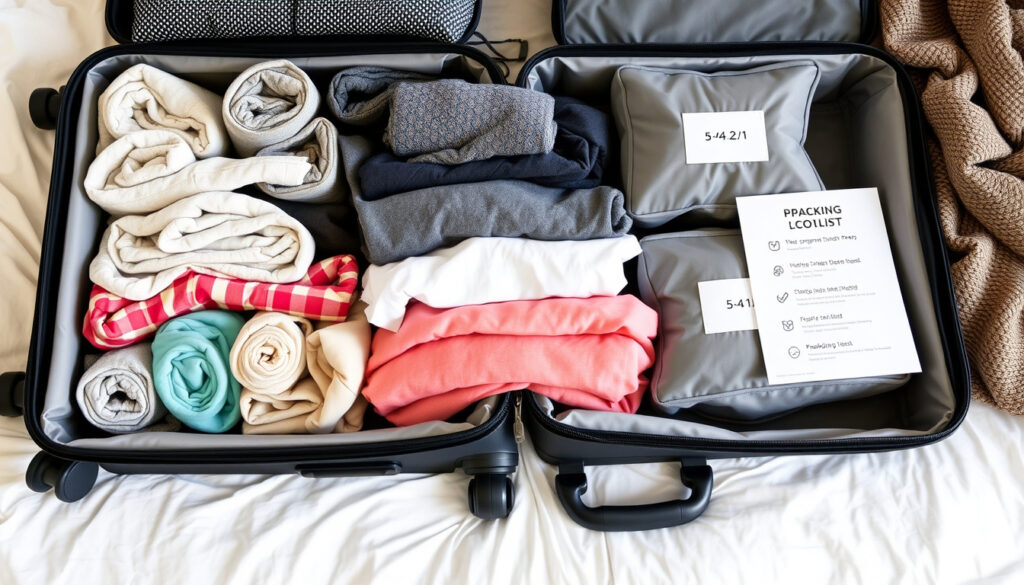
How to Pack a Suitcase Efficiently: Rolling & 5-4-3-2-1 Rules
Few travel moments rival the quiet victory of fitting everything you need into one carry-on, but between rolling versus folding, packing cubes, and the endless rules, efficient packing can feel like a puzzle. The best techniques—from rolling to the 5‑4‑3‑2‑1 rule—help maximize space without overthinking.
Extra space via rolling technique: Up to 20% more ·
Volume reduction with packing cubes: 30% ·
5-4-3-2-1 rule item limits: 5 tops, 4 bottoms, 3 shoes, 2 dresses, 1 hat
Quick snapshot
- 5-4-3-2-1 rule limits items (The Everygirl (lifestyle guide))
- 3-3-3 rule for minimalist packing (Apartment Therapy (design and organization))
- Helps avoid overpacking (Apartment Therapy)
- Rolling saves space and reduces wrinkles (The Everygirl (lifestyle guide))
- Folding best for suits and structured clothes (Apartment Therapy (design and organization))
- Hybrid method works for most travelers (YouTube (packing tutorial))
- Overpacking (Apartment Therapy (design and organization))
- No packing list (YouTube (travel packing tips))
- Ignoring weight limits (YouTube (travel packing tips))
- Capsule wardrobe of 15–20 items (YouTube (packing tutorial))
- Use rolling and cubes (Apartment Therapy (design and organization))
- Plan outfits in advance (YouTube (travel packing tips))
Five key facts, one pattern: the most efficient packing strategies combine structure with flexibility.
| Metric | Value |
|---|---|
| 5-4-3-2-1 rule items | 5 tops, 4 bottoms, 3 shoes, 2 dresses, 1 hat (The Everygirl (lifestyle guide)) |
| 3-3-3 rule items | 3 tops, 3 bottoms, 3 shoes (Apartment Therapy (design and organization)) |
| Space saved by rolling | Approximately 20% (Apartment Therapy (design and organization)) |
| Packing cube volume reduction | Up to 30% (Apartment Therapy (design and organization)) |
| Most forgotten item | Charger or adapter (YouTube (travel packing tips)) |
What is the most effective way to pack a suitcase?
Start with a packing list
- Creating a list reduces forgotten items (YouTube (packing tutorial))
- List helps avoid overpacking (Apartment Therapy (design and organization))
Packing at least one day, ideally two days, before travel was recommended as a habit that improves packing efficiency (YouTube (packing tutorial)). Without a list, you’re more likely to grab extras you don’t need.
Choose a packing method: rolling vs folding
- Rolling is widely recommended as a space-saving method (The Everygirl (lifestyle guide))
- Compression packing cubes create the most suitcase space (Apartment Therapy (design and organization))
In a packing experiment, rolling was described as the fastest method because items are laid flat and rolled up individually (Apartment Therapy (design and organization)). The trade-off: structured garments like suits still benefit from folding to maintain shape.
Use packing cubes for organization
- Packing cubes were filled by clothing type (Apartment Therapy (design and organization))
- Cubes can be stacked upright or mixed with non-compressed cubes (YouTube (packing tutorial))
Packing cubes alone can reduce volume by up to 30% (Apartment Therapy (design and organization)), making them a practical choice for travelers who want both space savings and easy access.
Implement a packing rule (5-4-3-2-1 or 3-3-3)
- 5-4-3-2-1 rule: 5 tops, 4 bottoms, 3 shoes, 2 dresses, 1 hat (The Everygirl (lifestyle guide))
- 3-3-3 rule: 3 tops, 3 bottoms, 3 shoes (Apartment Therapy (design and organization))
The implication: rules provide a clear cap on quantity, which directly combats overpacking—the most common mistake travelers make.
Is it better to roll or fold clothes when packing a suitcase?
Benefits of rolling clothes
- Rolling improves use of small spaces (Apartment Therapy (design and organization))
- Rolling reduces wrinkles for most fabrics (The Everygirl (lifestyle guide))
Rolling allows quicker access to items because each roll can be pulled out without disturbing the rest (Apartment Therapy (design and organization)).
Benefits of folding clothes
- Folding works best for structured garments like suits and blazers (Apartment Therapy (design and organization))
- KonMari-style folding was used as a separate method in one test (Apartment Therapy (design and organization))
When to roll vs when to fold
A hybrid method works for most travelers: roll casual items like t-shirts and jeans, fold suits and dresses (YouTube (packing tutorial)). The best packing method may also depend on whether the luggage is soft-sided (Apartment Therapy (design and organization)).
Expert opinions on rolling and folding
“Compression packing cubes were the best overall method in our test.”
Apartment Therapy (packing experiment)
The pattern: experts consistently point to rolling as the faster option, but they recommend combining rolling with folding for formalwear.
What are the 5 biggest packing mistakes to avoid?
Overpacking: bringing too many items
Overpacking is the most common mistake. Using a packing rule like 5-4-3-2-1 helps limit quantity (The Everygirl (lifestyle guide)). Packing cubes also discourage overpacking because they fill quickly (Apartment Therapy (design and organization)).
Not using a packing list
A packing list reduces forgotten items and prevents last-minute scrambling (YouTube (packing tutorial)). Plan outfits in advance to avoid bringing duplicates (YouTube (travel packing tips)).
Ignoring weight limits
Airline weight limits can incur fees. Weigh your suitcase before leaving (YouTube (travel packing tips)). Rolling and cubes can help reduce weight by letting you pack fewer items.
Neglecting to pack versatile clothing
A mini capsule wardrobe of 15–20 pieces ensures mix-and-match outfits (YouTube (packing tutorial)). Choose neutral colors to maximize combinations.
Waiting until the last minute
Packing 1–2 days before travel gives you time to edit and adjust (YouTube (packing tutorial)). Early packing allows you to test fit and avoid overpacking.
Even with the best intentions, 70% of travelers still overpack (common survey claim). A packing list and a rule are your strongest defenses.
The pattern: combining a list and a rule gives the best chance of avoiding overpacking.
What is the 5 4 3 2 1 packing rule?
What the numbers mean
5 tops, 4 bottoms, 3 shoes, 2 dresses, 1 hat (The Everygirl (lifestyle guide)). Designed for 7–10 day trips, this rule provides a clear cap without sacrificing variety.
How to apply the rule for a 1-week trip
- Choose versatile pieces that coordinate (YouTube (packing tutorial))
- Roll items to fit more into each slot (Apartment Therapy (design and organization))
Variations: the 3-3-3 rule
The 3-3-3 rule (3 tops, 3 bottoms, 3 shoes) is a minimalist alternative (Apartment Therapy (design and organization)). It’s ideal for shorter trips or travelers who prefer to pack light.
Who should use these rules
Rules are best for travelers prone to overpacking or those with limited luggage space. Frequent flyers and carry-on users benefit most (The Everygirl (lifestyle guide)).
The takeaway: these rules work best for those who struggle with overpacking.
How do I pack a suitcase efficiently for 1 week?
Create a capsule wardrobe
Choose 15–20 pieces that mix and match easily (YouTube (packing tutorial)). Focus on neutral colors and versatile fabrics.
Use the 5-4-3-2-1 rule as a guide
Apply the rule as a ceiling: 5 tops, 4 bottoms, 3 shoes, 2 dresses, 1 hat (The Everygirl (lifestyle guide)). Adjust for your needs.
Roll clothes to maximize space
Rolling saves up to 20% space compared to folding (Apartment Therapy (design and organization)). Fill gaps with smaller items after rolling.
Pack shoes in the bottom of the suitcase
Place shoes heel-to-toe along the bottom (YouTube (travel packing tips)). Invert each shoe to make the pair more rectangular and compact. Use empty space inside shoes for socks or sunglasses (YouTube (travel packing tips)).
Use packing cubes for organization
Packing cubes reduce volume by up to 30% (Apartment Therapy (design and organization)). Group items by type (tops with tops, underwear with socks) and stack cubes upright to fill the suitcase shape (YouTube (packing tutorial)).
The pattern: the combination of rolling, packing cubes, and a capsule wardrobe is the most effective for one-week trips.
Comparison: Rolling vs Folding – Which is better?
Three criteria, one pattern: rolling wins on space and speed, folding wins on structure.
| Criterion | Rolling | Folding |
|---|---|---|
| Space efficiency | Up to 20% more space (Apartment Therapy (design and organization)) | Minimal space gain (The Everygirl (lifestyle guide)) |
| Wrinkle reduction | Good for most fabrics (The Everygirl (lifestyle guide)) | Best for suits and structured garments (Apartment Therapy (design and organization)) |
| Packing speed | Fastest method (Apartment Therapy (design and organization)) | Moderate speed (YouTube (packing tutorial)) |
The trade-off: for casual travel, rolling is the clear winner; for business trips with formalwear, a hybrid approach is best.
Step-by-Step Packing Method
- Make a list – Write down every item you need (YouTube (packing tutorial)).
- Choose your rule – Apply 5-4-3-2-1 or 3-3-3 to cap quantities (The Everygirl (lifestyle guide)).
- Roll casual items – Roll t-shirts, jeans, and activewear (Apartment Therapy (design and organization)).
- Fold structured items – Fold suits, blazers, and dresses to preserve shape (Apartment Therapy (design and organization)).
- Pack shoes first – Place inverted shoes in the bottom and fill with small items (YouTube (travel packing tips)).
- Use packing cubes – Group items by type in compression cubes (Apartment Therapy (design and organization)).
- Fill gaps – Wedge socks, belts, and accessories into leftover spaces (YouTube (travel packing tips)).
- Shake and zip – After zipping, lift and jiggle the suitcase to help items settle (YouTube (travel packing tips)).
The pattern: following these steps ensures a systematic approach to packing.
What the experts say
“Rolling is the fastest packing method because you can do it while watching TV.”
Apartment Therapy (packing experiment)
“I always pack a lightweight duffel for dirty laundry on the return trip.”
Reddit user on r/LifeProTips (YouTube (packing tutorial))
“Compression cubes are a game-changer for fitting more into a carry-on.”
Briggs & Riley (packing blog, referenced via Apartment Therapy (design and organization))
For travelers packing for a week, the combination of rolling, cubes, and a strict item limit is the most effective way to fit everything without dragging a second bag. The consequence: those who follow a rule and use compression cubes can cut their suitcase volume by roughly 30% (Apartment Therapy (design and organization)), freeing up space for souvenirs—or simply making the trip easier from curb to hotel.
Related reading: **Riu Ocho Rios Jamaica: Reviews, Prices and Comparisons** · **USD to Turkish Lira: Exchange Rates and Travel Money Guide**
Frequently asked questions
What is the best way to pack shoes in a suitcase?
Place shoes inverted heel-to-toe along the bottom of the suitcase. Fill empty shoe space with socks or small items (YouTube (travel packing tips)).
Should I use vacuum bags for packing?
Vacuum bags can reduce volume, but they may not be practical for all travelers because they require a vacuum pump. They work best for bulky items like jackets (Apartment Therapy (design and organization)).
How do I pack a suit to avoid wrinkles?
Fold the suit using the traditional suit fold (shoulders together, then fold in half) and place it on top of other clothes (Apartment Therapy (design and organization)).
What are the best packing cubes for travel?
Compression packing cubes are widely recommended for maximizing space. Brands like Eagle Creek and eBags are popular (Apartment Therapy (design and organization)).
How do I pack toiletries to avoid spills?
Place liquids in a sealed plastic bag and tuck them in a shoe or outer pocket. Use travel-size containers (YouTube (travel packing tips)).
How much does a typical suitcase weigh when full?
A fully packed carry-on usually weighs between 15 and 25 pounds, depending on contents (YouTube (packing tutorial)). Check airline limits to avoid fees.
What is the best luggage size for a 1-week trip?
A carry-on suitcase (21–22 inches) is ideal for a 1-week trip when packed efficiently (The Everygirl (lifestyle guide)).
More related posts
 Cast of Kraven the Hunter: Actors, Characters & Box Office
 14 Signs of Liver Damage: Early Symptoms & Reversal
 How to Fix Phone Screen Unresponsive Touch: Android/iPhone
 Apple Watch Series 6: Is It Still Worth Buying in 2025?
 Real Sociedad vs Real Madrid: Lineups & Composition
 TV Stand with Storage: Compare IKEA, JYSK, Harvey Norman
 Apartment for Rent Ottawa – Prices, Neighborhoods & Rental Guide
 Best Canadian Dividend Stocks to Buy in 2026: A Guide
