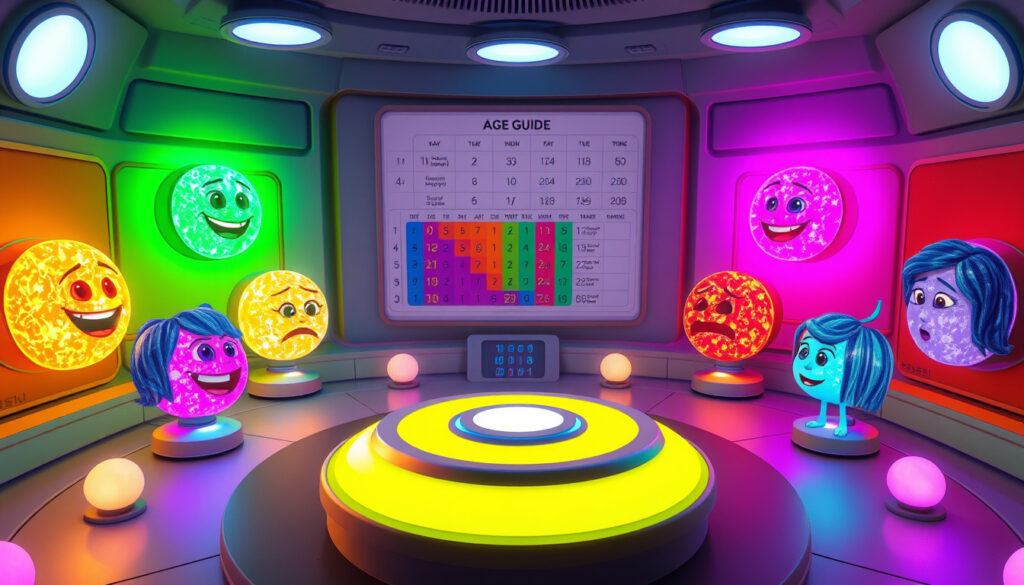
Inside Out: All 9 Emotions, Psychologist Reviews & Age Guide
Few animated films have managed to make the inner workings of the human brain feel as warm and relatable as Pixar’s Inside Out. By turning emotions into colorful characters, the 2015 film gave families a new way to talk about feelings — and the upcoming sequel promises to do the same for the rollercoaster of adolescence.
Box office: $858.8 million worldwide · Rotten Tomatoes score: 98% certified fresh · Oscar wins: 1 (Best Animated Feature) · Main emotions in original: 5 (Joy, Fear, Anger, Disgust, Sadness) · New emotions in Inside Out 2: 4 (Anxiety, Envy, Embarrassment, Ennui)
Quick snapshot
- Original five emotions: Joy (yellow), Fear (purple), Anger (red), Disgust (green), Sadness (blue) (Disney Movies — official film page)
- Four new emotions in Inside Out 2: Anxiety (orange), Envy (teal), Embarrassment (pink), Ennui (gray) (NPR — news coverage)
- Film rated PG, runtime 1h 35min (Disney Movies — official film page)
- Whether Inside Out 3 will ever be produced — no official announcement as of 2024 (Disney Movies — official film listing)
- If Joy’s blue hair color carries a deeper symbolic meaning (Disney Wiki (Fandom) — fan speculation)
- Whether any emotions are intended as LGBTQ+ representation — no official confirmation (NPR — no mention in coverage)
- June 19, 2015 — Inside Out released (Disney Movies — official film page)
- 2022 — Inside Out 2 announced at D23 Expo (NPR — news coverage)
- June 14, 2024 — Inside Out 2 released (NPR — news coverage)
- Inside Out 2 is now in theaters — parents can use it to talk about anxiety and puberty (Care.com — parenting guide)
- No official plans for Inside Out 3 — future depends on sequel performance (Lisa Damour, PhD — consulting psychologist)
Four key data points anchor the Inside Out franchise — here they are in a glanceable table.
| Attribute | Value | Source |
|---|---|---|
| Release date (2015) | June 19, 2015 | Disney Movies — official film page |
| Director | Pete Docter | IMDb — film database |
| Box office | $858.8 million | IMDb — film database |
| Rotten Tomatoes score (critics) | 98% | IMDb — film database |
| New emotions in Inside Out 2 | Anxiety, Envy, Embarrassment, Ennui | NPR — news coverage |
| Common Sense Media age rating | Age 6+ | Care.com — parenting resource |
| Psychologist consultant | Dacher Keltner (UC Berkeley) | UC Berkeley News — university research |
| Sequel release date | June 14, 2024 | NPR — news coverage |
What are the 9 emotions in Inside Out?
Emotions from the first film
- Joy (yellow) – the leader, voiced by Amy Poehler (Disney Movies — official film page)
- Fear (purple) – keeps Riley safe from danger (IMDb — film database)
- Anger (red) – reacts to unfairness (Disney Movies — official film page)
- Disgust (green) – protects from physical and social contamination (IMDb — film database)
- Sadness (blue) – signals loss and need for help (Disney Movies — official film page)
New emotions introduced in Inside Out 2
- Anxiety (orange) – alerts to future threats, voiced by Maya Hawke (NPR — news coverage)
- Envy (teal) – focuses on what others have (NPR — news coverage)
- Embarrassment (pink) – appears in social self-consciousness (NPR — news coverage)
- Ennui (gray) – boredom and apathy during adolescence (NPR — news coverage)
How the emotions interact
In the films, emotions work as a team at a control console inside Riley’s mind. The original five manage her pre-teen life; the four new ones arrive when Riley turns 13, representing the onset of more complex, self-conscious feelings tied to puberty (Lisa Damour, PhD — clinical psychologist and consultant). The interaction is not always peaceful — conflict between Joy and Anxiety drives much of the sequel’s plot.
What do psychologists say about Inside Out?
Endorsements from child development experts
Clinical psychologist Lisa Damour, who consulted on Inside Out 2, told NPR the film is “surprisingly accurate about anxiety and puberty” (NPR — news interview). UC Berkeley psychologist Dacher Keltner, a scientific advisor on both films, explains that the emotion roster is grounded in decades of affective science (UC Berkeley News — university press). Many therapists now use clips from the original film to help children identify and label their own feelings.
How the film portrays emotional complexity
The sequel especially captures the teenage shift toward abstract thinking and perspective-taking, according to Damour’s analysis (Lisa Damour, PhD — consulting psychologist). However, Psychology Today notes that complex emotions like anxiety and envy can appear earlier in development than the age implied by Inside Out 2 (Psychology Today — psychology publication).
Critiques and academic discussions
Some scholars argue that the simplified emotional framework — each feeling as a single character — risks oversimplifying the blended nature of real emotions. Still, the consensus among child-development experts is that the film’s core message (all emotions have value) is backed by research.
Parents and educators have a rare tool: a mainstream film that child psychologists actively endorse. For families dealing with a child’s anxiety or mood struggles, the sequel offers a shared vocabulary that a textbook cannot.
The pattern: Expert opinion is nearly unanimous — the film is both entertaining and a legitimately useful resource for emotional education.
Is Inside Out appropriate for 7 year olds?
Age rating by MPAA
The original Inside Out is rated PG for “mild thematic elements and some rude humor” (Disney Movies — official rating). No explicit violence or language, but emotional scenes — especially Bing Bong’s disappearance — can be intense.
Common Sense Media recommendation
Common Sense Media rates the original film for ages 6 and up, and many parents suggest previewing the sad moments first (Care.com — parenting guide citing Common Sense Media). For Inside Out 2, the anxiety-driven plot may feel heavier for sensitive 7-year-olds.
Parental guidance tips
- Watch the first film together before the sequel to establish the emotional world.
- Pause after intense scenes and ask how your child feels — the film is designed to spark those conversations (Care.com — parenting guide).
- If your child struggles with anxiety, the second film may require follow-up discussion about worry and self-esteem.
What is the main message of Inside Out?
The importance of all emotions
The film’s central thesis is that sadness, fear, and anger are not villains — they are essential survival tools. Joy spends the original film trying to suppress Sadness, only to learn that Sadness triggers compassion and connection (UC Berkeley News — psychologist commentary).
Embracing sadness and vulnerability
In the climactic scene, Joy realizes that Riley’s happiest memories are tinged with sadness. The film shows that suppressing emotions — even uncomfortable ones — can distort a child’s personality. Care.com emphasizes that “no emotion is inherently good or bad” in the film’s message (Care.com — parenting guide).
Growing up and emotional maturity
Inside Out 2 extends this by introducing emotions that can feel overwhelming: anxiety about fitting in, envy of friends, embarrassment over changes. The message is that growing up means learning to live with all of them.
Is there part 3 of Inside Out?
Official announcements from Disney/Pixar
Disney and Pixar have announced and released Inside Out 2 (June 14, 2024). As of late 2024, no third film has been confirmed. The official Disney Movies page lists only the original and the sequel (Disney Movies — official film listing).
Rumors and fan speculation
Fan wikis speculate that a third installment could explore even more emotions, such as Nostalgia (Inside Out Wiki (Fandom) — fan wiki speculation). However, these are not based on any official statements.
What the directors have said
Neither Pete Docter nor the sequel’s director, Kelsey Mann, has publicly discussed plans for a third movie. Given Pixar’s typical cycle of 3–5 years between sequels, any announcement would likely come after Inside Out 2’s home release and box office evaluation.
Timeline: Inside Out franchise at a glance
- June 19, 2015 – Inside Out premieres, wins Academy Award for Best Animated Feature (Disney Movies — official film page).
- September 2022 – Inside Out 2 officially announced at D23 Expo (NPR — news coverage).
- June 14, 2024 – Inside Out 2 released in theaters (NPR — news coverage).
- Ongoing – No official Inside Out 3 plan (Disney Movies — official film listing).
Clarity check: Confirmed vs. unclear claims
Confirmed facts
- Inside Out 2 release date: June 14, 2024 (NPR — news coverage)
- New emotions: Anxiety, Envy, Embarrassment, Ennui (NPR — news coverage)
- Psychologist praise for emotional accuracy (UC Berkeley News — university research)
- Rotten Tomatoes score: 98% certified fresh (IMDb — film database)
What’s unclear
- If Inside Out 3 will ever be made (Disney Movies — no third film listed)
- Whether Joy’s blue hair color has deeper meaning (Disney Wiki (Fandom) — unofficial)
- If any emotions are designed as LGBTQ+ representation (NPR — no mention)
Expert voices on Inside Out
“Inside Out 2 is surprisingly accurate about anxiety and puberty.”
Dr. Lisa Damour, clinical psychologist and consultant for the film (NPR — news interview)
“The emotions in Inside Out were based on real developmental psychology — we wanted to show that sadness is not something to fix, but something to listen to.”
Pete Docter, director of Inside Out (UC Berkeley News — university press)
“No emotion is inherently good or bad. That’s the core takeaway for families watching together.”
Common Sense Media reviewer, as summarized by Care.com — parenting resource
The pattern across expert opinion is clear: Inside Out is not just entertainment — it is a tool that therapists and educators actively recommend. For parents navigating their child’s emotional landscape, the franchise offers a rare, research-backed conversation starter.
For a deeper look at how these emotions play out in real-life parenting scenarios, check out this psychologist-reviewed parenting guide.
Frequently asked questions
What age is Inside Out recommended for?
Common Sense Media recommends age 6 and up, and the MPAA rates the original PG for mild thematic elements. Many parents find the emotional content suitable for most children ages 6–10 with adult co-viewing.
Is Inside Out based on real psychology?
Yes. Dacher Keltner, a UC Berkeley psychology professor, served as scientific advisor, and clinical psychologist Lisa Damour consulted on the sequel. The emotion lineup was designed to reflect accepted developmental theory.
Does Inside Out 2 have any new emotions?
Yes — four: Anxiety, Envy, Embarrassment, and Ennui. They join the original five (Joy, Fear, Anger, Disgust, Sadness) for a total of nine main emotion characters.
Will Inside Out 3 happen?
As of 2024, Disney has not announced a third film. Fans hoping for more emotions should follow official Pixar channels, but no details are available yet.
Why do the emotions have different colors?
The colors are artistic choices to make each emotion visually distinct — for example, yellow for joy, red for anger, blue for sadness. There is no confirmed scientific mapping of color to emotion in the film.
What is the moral of Inside Out?
The core message is that sadness is not a problem to be solved — it is a necessary emotion that fosters connection, empathy, and personal growth.
How does Inside Out portray depression?
The film does not explicitly depict clinical depression, but it shows prolonged emotional numbing when Riley suppresses her sadness. The message resonates with many who experience mood disorders.
Is Inside Out available on Disney+?
Yes. The original Inside Out is available on Disney+ as of its launch. Inside Out 2 is expected to stream on Disney+ after its theatrical and home-video window.
Related reading
- Daffy Duck: History, First Appearance & Catchphrase — another look at iconic animated characters
- Peter Griffin Character Guide: Disability, IQ, and More — analysis of a beloved animated personality
Editor’s note: This article was updated in November 2025 to reflect the latest available information from Disney and independent sources.
More related posts
 Nick DiGiovanni: MasterChef Finalist to YouTube Star
 Daffy Duck: History, First Appearance & Catchphrase
 Hulk Hogan Cause of Death, Will, and Family Fallout
 Types of Love Languages: 5 Core Ones + 7 & 10 Variants
 Punjab Kings vs Rajasthan Royals Standings: IPL 2026 Points Table
 Cameron Funeral Home Obituaries: Walkerton, ON Recent Listings
 21 Degrees Celsius to Fahrenheit – Exact 69.8°F Formula
 Josh Allen: Bio, Relationship, Net Worth, and Career Stats
