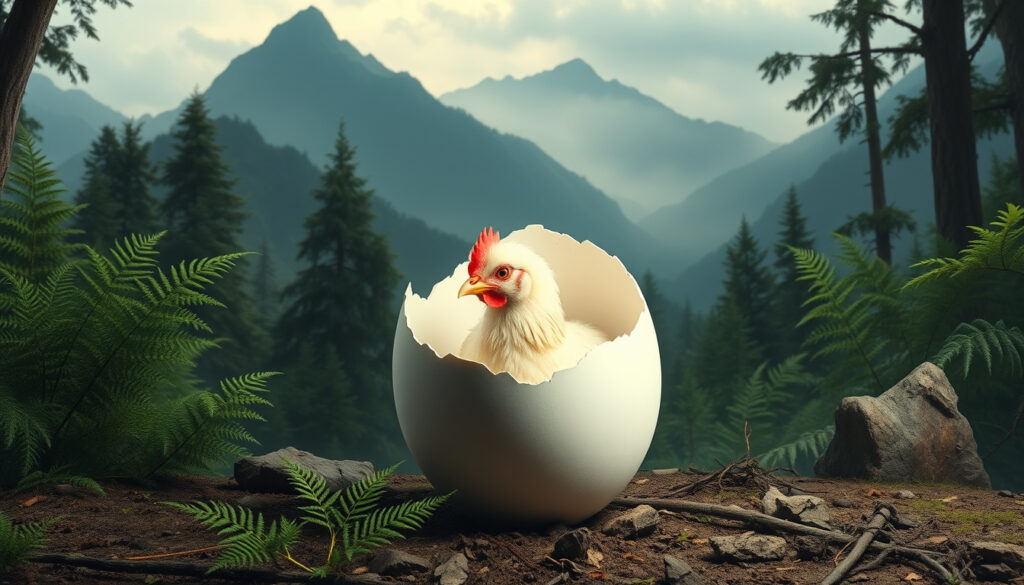
What Came First the Chicken or the Egg – The Evolutionary Answer
The question of which came first—the chicken or the egg—has lingered for centuries, crossing the boundaries of philosophy, science, and religion. It is a puzzle that has prompted genuine inquiry into causality, evolution, and the origins of life itself.
Scientists overwhelmingly conclude that the egg preceded the chicken, though the answer requires understanding the vast timescales involved and how species diverge through genetic mutation. Rather than a simple trivia question, this paradox touches on fundamental principles of evolutionary biology.
Scientifically, What Came First: The Chicken or the Egg?
From a strictly biological standpoint, the egg came first. Eggs in general evolved hundreds of millions of years before chickens existed as a species. The first amniote eggs—hard-shelled eggs capable of being laid on land—appeared approximately 312 to 340 million years ago. Chickens, by contrast, are domesticated descendants of the red junglefowl that arose only 8,000 to 58,000 years ago, depending on whether one relies on archaeological or genetic evidence. This gap of hundreds of millions of years means eggs predated chickens by an enormous margin.
How Genetic Mutation Created the First Chicken
The actual mechanism behind the transition involves speciation through evolution. When two proto-chickens—nearly-chickens that were genetically similar but not yet identical—mated, a genetic mutation in their offspring’s zygote produced the first true chicken. In practical terms, a bird that was almost—but not quite—a chicken laid an egg containing DNA that, through accumulated mutations, resulted in a genuine chicken.
This process aligns with Darwinian evolution, in which genetic changes occur in germ cells through random mutations. According to research published through the National Institutes of Health, the “egg first” scenario corresponds directly with the Modern Synthesis of evolutionary biology, which combines Darwin’s natural selection with Mendelian genetics.
Some researchers have proposed an alternative mechanism called epigenetic inheritance, where organisms transmit adaptive changes acquired during their lifetime to offspring through non-genetic processes. This model resembles Lamarckian evolution and, in theory, would support a “chicken first” scenario. However, the Darwinian model remains the dominant scientific explanation for how new species arise.
The Ovocleidin-17 Protein Argument
Research into chicken eggshell formation introduced a seemingly compelling counterargument. Chickens produce ovocleidin-17 (OC-17), a protein found exclusively in the hen’s ovary that enables calcium carbonate shell formation, allowing eggs to develop and hatch within 24 hours. Some scientists initially argued that the chicken must have come first, since the protein enabling eggshell formation is produced by the hen rather than the egg itself.
However, subsequent analysis revealed that OC-17 or homologous proteins appear in other bird species, including turkeys and finches. This indicates that eggshell-reinforcing proteins predate chickens and evolved gradually alongside avian species. Rather than undermining the egg-first conclusion, the protein’s evolutionary history actually supports it. Studies from Cambridge University have documented these protein similarities across species.
Key Facts at a Glance
| Fact | Details | Evidence Type |
|---|---|---|
| First amniote eggs | Approximately 312–340 million years ago | Fossil and comparative biology |
| Chicken domestication | Approximately 10,000 years ago | Archaeological record |
| Genetic divergence estimates | 8,000 to 58,000 years ago | DNA analysis and modeling |
| Key protein involved | Ovocleidin-17 (OC-17) in hen’s ovary | Biochemical research |
| Speciation mechanism | Mutation in proto-chicken zygote DNA | Evolutionary biology |
| Parent species | Red junglefowl, likely with grey junglefowl genetic contributions | Genetic studies |
What Is the Philosophical Perspective on the Chicken or Egg Dilemma?
The chicken-or-egg question is among the oldest philosophical paradoxes on record, predating modern science by millennia. It raises fundamental questions about causality and the problem of infinite regress—when one searches for a first cause only to discover that cause depends on an earlier cause, and so on indefinitely.
Ancient Philosophical Roots
The Greek philosopher Anaximander, active in the sixth century BCE, addressed this paradox and expressed a view remarkably similar to evolutionary thought. Anaximander proposed that species transform over time and that chickens had non-chicken ancestors. The classical version of the paradox, often attributed to Aristotle’s philosophical tradition, was used to illustrate the difficulty of identifying ultimate causes in natural phenomena. These early thinkers recognized that some questions about origins resist easy answers precisely because they involve circular dependencies.
Why the Dilemma Appears Paradoxical
The apparent paradox arises because the question implies a binary choice: a chicken must hatch from an egg, but that egg must come from a chicken. This circular logic suggests neither could exist without the other, creating an irresolvable loop. The fallacy lies in applying this logic to a process that unfolds over millions of years rather than within a single generation.
When examined across evolutionary timescales, the circularity dissolves. Eggs existed for hundreds of millions of years before chickens evolved, making the apparent paradox a false one. The question only appears unanswerable when one ignores the geological and genetic context.
What Do Religious Views Say About Which Came First?
Religious traditions offer different perspectives on the origins of chickens and eggs, generally placing emphasis on divine creation rather than evolutionary processes. In several faith traditions, life is understood to originate through intentional divine action, which positions the chicken—and by extension the mechanism by which it produces eggs—as the primary creation.
Creationist interpretations typically hold that chickens were created fully formed, which would suggest the chicken came before any egg. Under this framework, the question of precedence is resolved not through biological mechanism but through theological understanding of creation. The specific details vary considerably across traditions, with some accounts describing birds as a deliberate creation while others frame eggs as part of a broader created order.
It is worth noting that the research sources consulted do not extensively document the religious perspective, and any summary of those views carries inherent limitations. The scientific consensus, based on available evidence, clearly favors evolutionary processes over miraculous creation as the explanation for chicken origins. This article focuses primarily on the scientific and philosophical dimensions where the most detailed evidence is available.
What Is the Timeline of Chicken Evolution and Domestication?
Understanding when chickens entered the picture requires separating the history of eggs as a reproductive strategy from the relatively recent emergence of the domestic chicken. The following milestones outline the key evolutionary and domestication events relevant to the question. Research from institutions like the Natural History Museum has helped establish these timelines.
- Approximately 340 million years ago: The first amniote eggs—hard-shelled eggs capable of developing on land—appear in the fossil record, predating birds by a vast margin.
- Approximately 65 million years ago: Dinosaur eggs have already existed for tens of millions of years, representing the broader evolutionary lineage from which birds eventually descended.
- 58,000 to 10,000 years ago: Genetic evidence suggests divergence between red junglefowl ancestors and what would become domestic chickens occurred between 58,000 and 8,000 years ago, with archaeological evidence pointing to domestication approximately 10,000 years ago.
- Approximately 10,000 years ago: Red junglefowl domestication is underway in Southeast Asia, based on archaeological findings from multiple sites in the region.
- Gradual transition: Proto-chickens continue interbreeding with wild junglefowl, with hybridization potentially contributing traits such as yellow leg coloration from the grey junglefowl.
- First true chicken: The precise moment when genetic mutations in a proto-chicken zygote produced a genetically distinct chicken remains undefined, as the threshold for defining a species boundary is inherently somewhat arbitrary.
Is the Chicken Egg Dilemma Resolved?
The question of whether the chicken-or-egg dilemma has a definitive answer depends significantly on how one defines the terms involved. Below is a comparison of what is firmly established and what remains open to interpretation.
Established Information
- Amniote eggs existed approximately 312–340 million years ago
- Domestic chickens descended from red junglefowl
- Genetic mutations in zygotes cause speciation events
- OC-17 protein exists in multiple bird species
- Domestication occurred approximately 10,000 years ago
- Evolutionary biology supports the egg-first scenario
Remaining Uncertainties
- Precise genetic threshold defining “first true chicken”
- Extent of hybridization among junglefowl species
- Whether the specific egg containing the first chicken is identifiable
- Full implications of epigenetic inheritance mechanisms
As a Harvard researcher noted, the answer may occasionally involve simultaneous rather than sequential developments—analogous to how oxygen-producing photosynthesis and oxygen-consuming aerobic metabolism likely coevolved at life’s origin. In this framing, the question may resolve not to one side or the other but to an acknowledgment that evolution sometimes produces interdependent developments that resist simple causal ordering.
Understanding the Evolutionary Framework
The broader context of this question lies in how evolutionary biology explains the emergence of new species. Rather than a single dramatic mutation producing a chicken from a non-chicken, speciation typically involves gradual accumulation of genetic changes across generations. These changes occur in the germ cells—sperm and egg—meaning the vehicle of inheritance, not the adult organism, is where evolutionary novelty originates.
This principle applies far beyond chickens. The same logic explains why the first whale did not emerge from a fish, or why the first tetrapod did not emerge from a fish. Evolution acts on reproductive cells, and reproductive cells in birds and many other species are encapsulated in eggs. Consequently, the egg serves as the vehicle through which genetic changes propagate, making it logically and temporally prior to the organism that carries those changes. For those interested in broader evolutionary mechanisms, Science Daily provides regular coverage of evolutionary biology research.
What Do Scientists Say About the Chicken or Egg Question?
The scientific community has engaged with this question through multiple disciplines, including evolutionary biology, genetics, and biochemistry. The consensus is resoundingly in favor of the egg, though the nuances of the argument require careful presentation.
The question of whether a “chicken egg” specifically came first requires acknowledging that the distinction between proto-chicken eggs and the first modern chicken egg is somewhat arbitrary, determined by whichever genetic mutations one identifies as defining “true” chickens. The paradox dissolves when considering evolutionary timescales.
— Encyclopedic and scientific sources, including peer-reviewed research and university publications
Research published in journals addressing evolutionary mechanisms demonstrates that the egg-first scenario aligns with the Modern Synthesis—the comprehensive framework combining Darwinian natural selection with Mendelian genetics. According to this model, random mutations occurring in germ cells produce heritable variation, and natural selection acts on that variation over successive generations. In this framework, the egg is not merely a container but the arena in which genetic change unfolds. Publications from University of Chicago Press journals have explored these frameworks in depth.
Studies examining the ovocleidin-17 protein have further reinforced this view. While the protein’s presence in the hen’s ovary initially suggested the chicken preceded the egg, the discovery of analogous proteins in turkeys, finches, and other species demonstrated that these proteins evolved alongside birds generally rather than being innovations unique to chickens. Research documented by Encyclopaedia Britannica has tracked these developments in comparative biochemistry.
The Bottom Line on Which Came First
The egg came first—not by a narrow margin, but by hundreds of millions of years. Eggs as a reproductive strategy predated chickens by an enormous stretch of geological time. The specific genetic mutation that produced the first true chicken occurred inside an egg laid by a proto-chicken, and the evolutionary process that enabled this transition operated across generations rather than within a single lifetime. While the philosophical dimensions of the question remain genuinely interesting, the scientific evidence unambiguously supports the egg-first answer. For a broader understanding of how species evolve and diverge, exploring the relationship between ancestral traits and modern characteristics provides valuable context, such as in studies of Parts of a Plant that examine evolutionary adaptations across different organisms.
Frequently Asked Questions
Which came first, the chicken or the egg?
The egg came first. Eggs evolved approximately 340 million years ago, while chickens emerged only 8,000 to 58,000 years ago through the domestication and genetic divergence of red junglefowl.
Is the chicken egg dilemma resolved?
Yes, from a scientific perspective. The egg preceded the chicken because genetic mutations that cause speciation occur in germ cells inside eggs. The apparent paradox dissolves when examined across evolutionary timescales rather than a single generation.
Did a non-chicken lay the first chicken egg?
Essentially, yes. Two proto-chickens—a nearly-chicken species—produced offspring through an egg containing a genetic mutation that resulted in the first true chicken. The egg came from a non-chicken, but the hatching organism was a chicken.
What does evolution say about the chicken or egg?
Evolution explains that species change through random genetic mutations in germ cells. The egg serves as the vehicle for these changes, meaning the egg necessarily precedes the new organism. This aligns with the Modern Synthesis of evolutionary biology.
When was the first chicken domesticated?
Archaeological evidence indicates red junglefowl domestication began approximately 10,000 years ago. Genetic analysis and mathematical modeling suggest the divergence may have started as early as 58,000 years ago.
What do scientists say about the chicken or egg question?
Scientists consistently point to the egg based on evolutionary biology. Research from university departments, peer-reviewed journals, and comparative biochemical studies confirms that eggs predate chickens by hundreds of millions of years.
What is the philosophical answer to the chicken or egg dilemma?
Philosophically, the question illustrates the problem of infinite regress in causality. Ancient philosophers including Anaximander and thinkers within Aristotle’s tradition recognized the difficulty of identifying an ultimate beginning. The paradox resolves when one accounts for the timescales and mechanisms involved.
More related posts
 Daisy Edgar-Jones: Biography, Relationships, and Career Facts
 Community Living: Types, Benefits, and Key Questions Answered
 Condo for Sale Montreal: 6,206 Listings & Prices
 John Schneider Baseball: Minor League Career & Blue Jays Manager
 Jackie Robinson: Biography, Legacy & Why 42 Is Retired
 George Strait: Tragedy, Trump, Bezos & Faithfulness
 Elaine Hendrix: Children, Marriage & Friendship with Lisa Ann Walter
 Where’s Waldo: Name Origins, Controversies, and Cultural Impact
